
The Market That Sets the Standard for Private Aviation
 New York is not just the largest private aviation market in the United States. It is the market that sets the operating standard against which every other US market is measured. The density of experience among operators, FBO staff, and ground handling crews at Teterboro, Westchester County Airport, and the other New York metro facilities produces a level of operational polish that comes from processing an enormous volume of high-expectation clients year after year. This is why experienced private flyers who have traveled extensively often say that the New York private aviation experience, specifically the Teterboro ground experience, sets the benchmark for what the product should deliver.
This guide is for frequent private flyers who use New York as their primary departure market and want a comprehensive picture of how to navigate it most effectively, from airport selection and operator choice to the specific corridors where empty leg supply is strongest and the timing that produces the best combination of availability and pricing.
The Four Airports and Who Each One Serves Best
Teterboro Airport in Bergen County, New Jersey is the primary private aviation hub for the New York metro area and handles more private jet movements than any other facility in the region. The combination of its location relative to Manhattan, the quality of its FBO operators, and the density of Part 135 charter operators based there makes it the default choice for most Manhattan-based private aviation clients. Ground transit from Teterboro to Midtown Manhattan via the George Washington Bridge runs 20 to 40 minutes in normal traffic and significantly longer during peak commute hours.
Westchester County Airport at HPN in White Plains is the right choice for clients heading to or coming from Greenwich, Stamford, and the Connecticut suburbs. By routing through HPN rather than Teterboro, these travelers eliminate the need to go into or through Manhattan entirely and reduce their total ground transit time by 30 to 50 minutes each way. HPN handles a meaningful volume of corporate charter traffic and its private aviation facilities, while smaller than Teterboro's, are more than adequate for the full range of domestic charter aircraft.
Republic Airport at FRG on Long Island serves the Nassau County, Hamptons, and eastern Long Island market. During the summer season, FRG handles significant traffic from Manhattan-based clients heading to weekend properties in the Hamptons, and the volume during peak summer weekends can create ramp congestion at FRG that affects departure timing. For clients with flexibility, departing on Friday afternoon rather than Friday evening significantly reduces the ground experience friction during peak summer periods.
The Strongest Empty Leg Corridors from New York
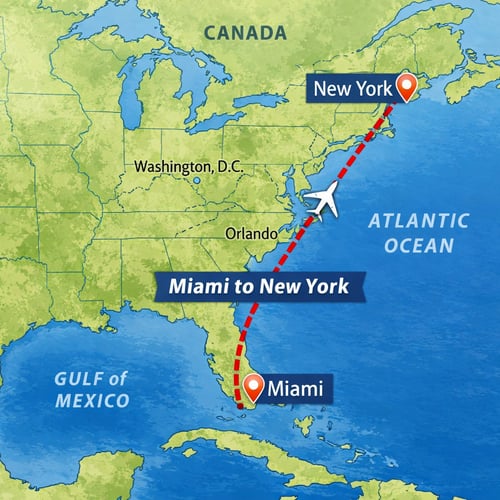 New York generates the highest volume of southbound empty leg supply during the late fall and early winter as the seasonal HNWI migration to Florida begins. Aircraft that deliver New York clients to Miami and Palm Beach in November and December frequently reposition north as empty legs, creating the southbound inventory that Florida-bound travelers can access at significant savings. The New York to Miami route page shows current southbound availability in real time.
The New York to Los Angeles transcon route generates consistent bidirectional empty leg supply year-round driven by the entertainment and finance industry connections between the two cities. Unlike the seasonal Miami corridor, the NY-LA empty leg supply is relatively consistent throughout the calendar without the dramatic seasonal peaks. Transcon empty legs on super-midsize and heavy jets, when they surface, represent some of the most financially significant opportunities in domestic private aviation given the high standard charter rates on this five-plus hour route. The broader empty leg inventory shows all available legs across all New York departures in real time.
Corporate Travel from New York: The Time Value Case
The case for private aviation from New York is strongest for corporate travelers whose time has a quantifiable financial value and who travel frequently between New York and the destinations where the private aviation time saving is most dramatic. The New York to Washington DC corridor, the New York to Boston corridor, and the New York to Chicago route are all situations where the total door-to-door advantage of private aviation over the commercial alternative is substantial. For a New York attorney who bills at $900 per hour and needs to be in Washington for a morning meeting, the two to three hours of effective working time recovered by flying private rather than commercial on the early morning Acela represents more than the cost difference between the two options.
This calculus is what drives the consistent corporate charter demand in the New York market that persists year-round regardless of seasonal leisure patterns. Corporate travel from New York is not seasonal. It tracks the business calendar, which means the New York private aviation market is busier during earnings season, during major deal processes, and during the fall conference season than during summer vacation weeks. For corporate clients who want to structure their aviation access to match this pattern, a direct operator relationship through charter-quote provides better flexibility than any commitment-based program.